
Team coaching and effectiveness
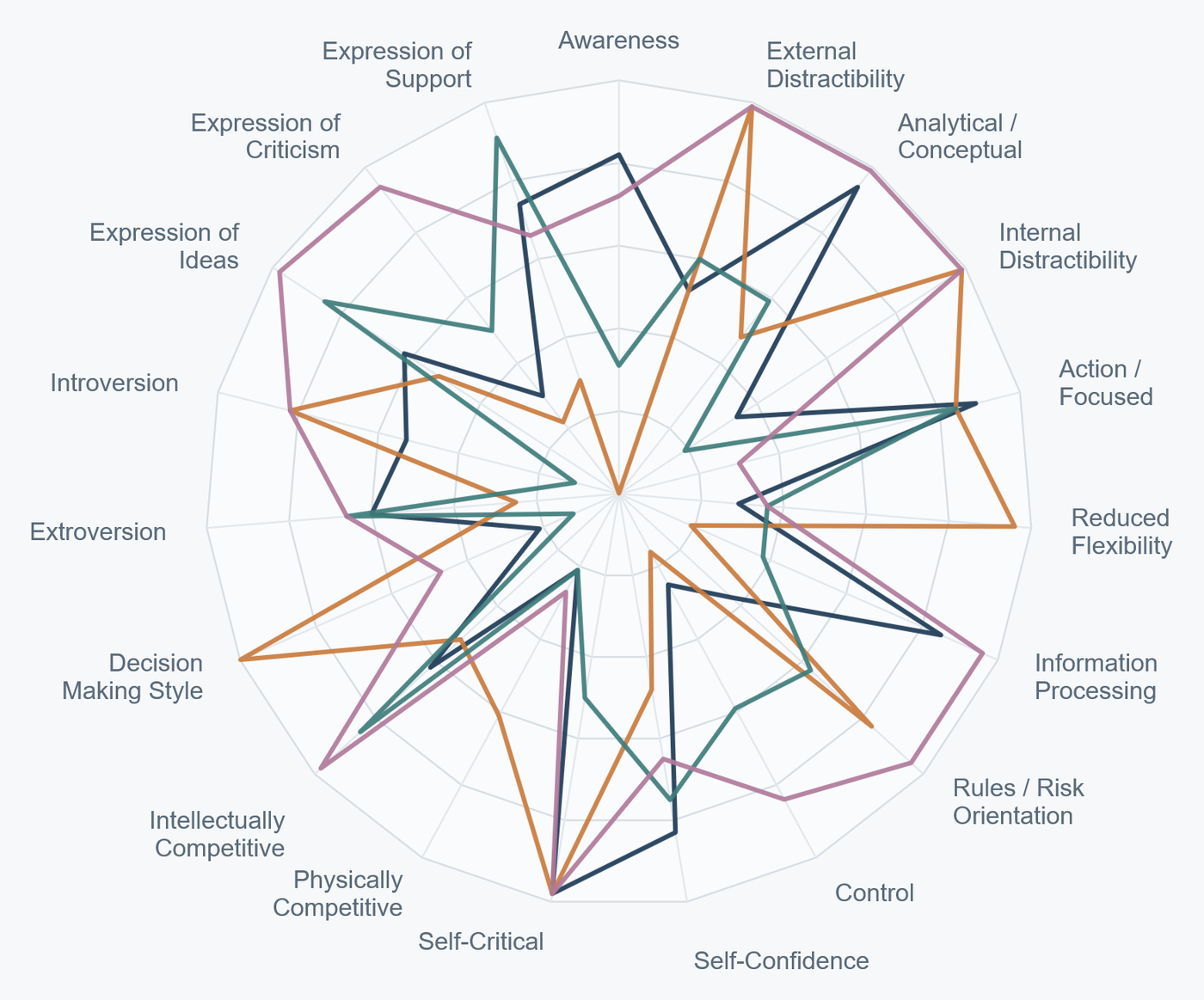
The team has the talent but not the results. We map each member’s spiky profile, then design and coach the team so strengths complement each other.
The challenge
Teams today are often unintentionally monocognitive: built around dominant communication styles, linear processes, and neurotypical norms of participation. Neurodistinct team members are frequently under-leveraged, misread, or quietly exhausted.
As complexity accelerates, organizations that cannot access the full range of their cognitive diversity will consistently lose adaptive advantage to those that can.
How it works
We engage the full team, not just the neurodistinct individuals within it. Team coaching is not sensitivity training. It is systems redesign.
- Assessment and spiky-profile mapping of each member to show where the team is strong, where it is exposed, and where members complement one another.
- Team design and composition: using the profiles to shape roles, pairings, and, for new or reconfigured teams, who should be on the team.
- 4–6 month coaching engagement with the team lead and key members, structured around real work challenges.
- Team operating agreements redesigned to support diverse cognitive styles in communication, planning, and decision-making.
- Embedded facilitation techniques that draw out contribution from non-dominant cognitive voices.
- Manager coaching to develop the neuroinclusive leadership skills that sustain the work beyond the engagement.
What changes
Teams move from tolerance to integration. They develop shared language for cognitive difference, more equitable meeting and collaboration practices, and measurably higher contribution from neurodistinct members.
Leaders gain confidence in building psychologically safe, high-performing environments. The most significant return is a team operating at its full cognitive potential, where complementary strengths translate into better outcomes.
Who this is for
- Team leaders managing neurodiverse teams who want to unlock their team’s full cognitive potential.
- Leaders forming or reconfiguring a team who want to build it around complementary strengths.
- HR Business Partners supporting teams with neurodistinct members.
- Organizations committed to turning neuroinclusion from policy into practice.
Related programs
Start with the team you have
Many people who think differently have no formal diagnosis. Our approach does not require one and does not provide one.